Safety
Comments: No Comments
Every June, the National Safety Council (NSC) observes National Safety Month to bring additional attention to occupational health and safety (OHS) issues, reinforce the importance of having a strong safety culture, and encourage employers and individuals to be safety role models. This June marks 30 years of celebrating National Safety Month and keeping people safe—from the workplace to anyplace.
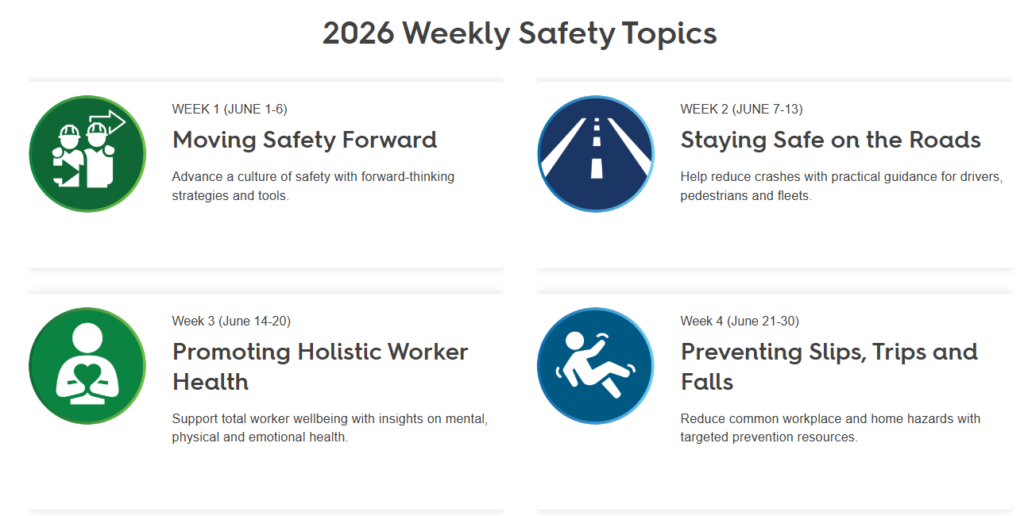
NSC has established four focus areas for 2026:
- Moving Safety Forward
- Staying Safe on the Roads
- Promoting Holistic Worker Health
- Preventing Slips, Trips, and Falls
KTL digs deeper into each focus area below:
Moving Safety Forward: OHS Document Management Systems
An OHS Document Management System provides a company-wide framework for central, secure storage and organization of safety-related documents and records to elevate workplace safety and move it forward in the organization. This includes policies, procedures, training records, inspection reports, and regulatory documentation to comply with Occupational Safety and Health Administration (OSHA) requirements.
Safety records often have strict retention and security requirements and must be accessible for an audit at any time. A structured OHS Document Management System can help ensure that these critical files are not only retained according to OSHA requirements, but also are standardized, easily searchable, and available to the right people when they need them. Read more…
Staying Safe on the Roads: Fleet Safety
A fleet is not limited to tractor-trailers or large delivery operations. If employees drive cars, vans, pickups, or other vehicles for work, the organization likely has fleet exposure and should manage it accordingly. Essentially, if vehicles are used in commerce, employers need to define fleet scope; evaluate applicable requirements; and treat driving as a safety, liability, and operational risk issue.
Fleet safety requires several core controls, including a written Fleet Safety Policy, driver screening and qualification, defensive driving training, and refresher training. Policies should address seat belt use; distracted driving; drug and alcohol prohibitions; and reporting of crashes, theft, and vehicle damage. If employees drive for work, fleet safety needs to be formalized to protect employees and the organization. Read more…
Promoting Holistic Worker Health: Psychological Safety
Workplace safety and health goes beyond the physical. A strong safety culture focuses on the whole person, and that includes ensuring psychological safety. Psychological safety is the shared belief that it is okay to take risks, express concerns and ideas, ask questions, speak up, and admit mistakes in the workplace without fear of being punished or humiliated.
Psychological safety is a critical concept for building effective teams and, many would argue, a critical concept for encouraging workplace innovation and success. According to the Center for Creative Leadership research, teams with high degrees of psychological safety report higher levels of performance and lower levels of interpersonal conflict. This is because employees who feel their workplace is psychologically safe are more willing to engage in behaviors that contribute to greater organizational innovation. Read more…
Preventing Slips, Trips, and Falls: Walking-Working Surfaces
Slips, trips, and falls routinely hit the top of OSHA’s Top 10 Violations. Walking-working surfaces include any horizontal, vertical, or inclined surface employees use to walk, work, or access a work area. That includes floors, stairs, ladders, platforms, scaffolds, ramps, and roofs. It’s important to remember that slip, trip, and fall risk is not limited to elevated work. Same-level hazards such as clutter, spills, cracks, holes, unmarked surface changes, and poor housekeeping can be just as significant and need to be managed as routine safety control issues.
OSHA 29 CFR 1910 Subpart D is the primary general industry standard for walking-working surfaces. To meet these standards and keep employees safe, there are several core controls employers should implement, including keeping surfaces clean and orderly, maintaining dry conditions where feasible, correcting defects promptly, ensuring safe access and egress, and confirming surfaces can support intended loads. In short, employers should treat walking-working surface hazards as an inspection, maintenance, and training issue, not just a housekeeping issue. Read more…
Additional Resources
As part of National Safety Month, NSC is offering free resources in these four areas (and more!) to help prevent injuries and safe lives. Check out these resources and take the NSC SafeAtWork Pledge to commit to:
- Actively helping your employer improve safety programs.
- Reporting hazards promptly and suggesting solutions.
- Being a good safety role model for coworkers, friends, and family, even off the job.