Environment
Comments: No Comments
ISO 14001 is the international standard for Environmental Management Systems (EMS). It serves as a management tool for voluntary use by organizations to help improve environmental performance and minimize environmental risks following a plan-do-check-act (PDCA) approach. ISO 14001 was first published in 1996 by the International Standard for Organization. It has since been updated with revised versions in 2004 and 2015. The recent ISO 14001:2026 revision—published in April 2026—marks the first major update to the ISO 14001 standard since 2015.
Impetus for Change
The global sustainability landscape has shifted significantly since ISO 14001:2015 was published, prompting the 2026 updates. Organizations face more stringent regulatory requirements; greater supply chain scrutiny; and heightened demand for environmental, social, and governance (ESG) transparency and accountability. The ISO 14001:2026 updates refine, strengthen, and modernize EMS requirements to align the standard with growing environmental and sustainability pressures and increasing stakeholder expectations.
In addition, ISO 14001:2026 implements the Harmonized Structure (Annex SL) to align with other ISO management system standards. This standard structure allows for easier integration between management systems and improved efficiencies due to familiar terminology and sections. The standard also now includes at what point in the PDCA cycle each clause lands. While this isn’t new for ISO, it is new for ISO 14001:2026.
Major Clause‑Level Changes
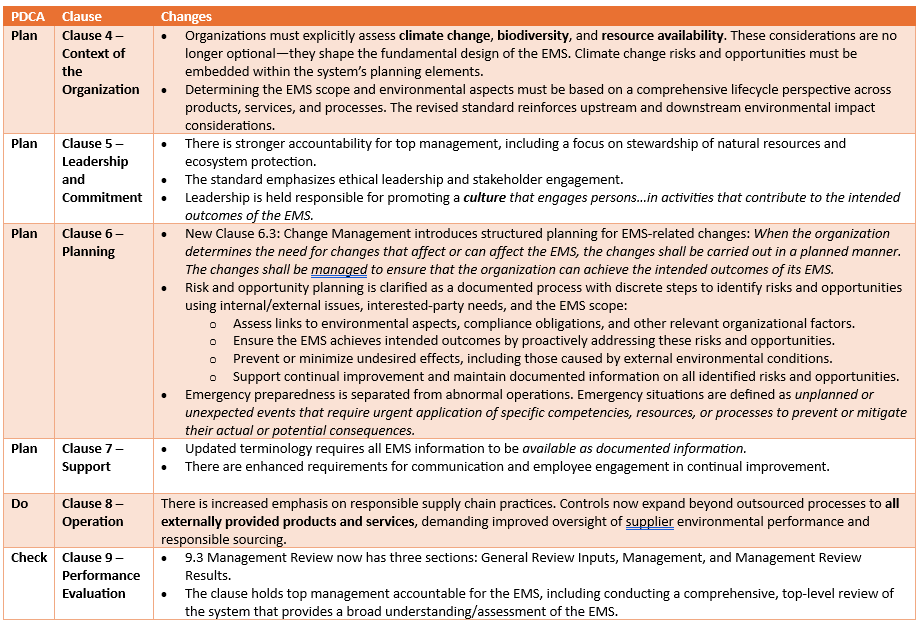
The ISO 14001:2026 revision incorporates changes to enhance climate awareness, lifecycle responsibility, supplier oversight, and leadership accountability. The table below outlines the major clause-level changes in the revised standard.
In addition to the major clause changes outlined above, the updated standard:
- Encourages the use of digital tools and data analytics to improve environmental performance and evidence‑based decision‑making.
- Introduces clearer, more accessible wording, as well as improved examples and explanations in Annex A.
- Embeds stronger expectations for integrity, transparency, and environmental governance at the leadership level.
Transition Timeline: How to Prepare
Organizations will have a three‑year transition period to switch to the new standard. Taking the time to adapt and integrate the new provisions into their operations now will help ensure certification when the transition period is over:
- Get informed! Start reading up on ISO 14001:2026 to get familiar with how the new standard is structured and how the clause changes impact your organization.
- Conduct a gap assessment to identify gaps in your existing EMS that will need to be addressed to meet new requirements. If you don’t have an existing EMS, review the requirements and determine what pieces you may already have in place to pursue certification.
- Develop an implementation plan that integrates leadership accountability, new change management processes, expanded documentation expectations, and more rigorous climate and biodiversity integration. There is a three-year transition period. Plan according to this timeline.
- Provide training. It is vital to ensure that workers and management are engaged in the EMS and that they are competent in any new skills/responsibilities that may be required.
- Put your plan into action. Update/develop your EMS to meet the ISO 14001:2026 requirements and provide verification of its effectiveness to help ensure certification when the three-year transition period is over.